
Product design and build for a deal inbox for US angel investors
2026

Assay
for angel investors
About the project
A deal inbox that turns a pile of pitch decks into decisions an investor can look back on
Market
United States
Year
2026
Built with
Next.js, Supabase, Stripe and Claude
The problem
Assay is a US startup for solo angels and micro-VC partners who see 50 to 80 decks a month across email, DocSend and LinkedIn. The founders came with a working concept: upload a deck, get an AI score out of 100. Every investor already has a free tool that does that: they paste the deck into ChatGPT. Deal tools summarise the deck and stop there, and the investor still sorts the inbox, checks the numbers by hand and forgets why they said no six months ago. A summary could not be the product. Everything before and after it could.
Scope of work
Product design
Design system
Landing page
Development
Key decisions
What we designed and why
The inbox is the home screen
Investors forward decks from email, DocSend and LinkedIn to one Assay address. Each deck is checked against their thesis, and the ones outside it are set apart.

Every number in the deck is checked
Slide 4 says $2.4M ARR, slide 7 says 12 customers at $15K, which is $180K. Assay checks each claim against public sources and shows the slide it came from.

A plain answer instead of a score
Investors do not trust a number out of 100 they cannot unpack. The deal page says in words whether a deal is worth a call and what to ask, and it works on a phone, where the first call often happens.

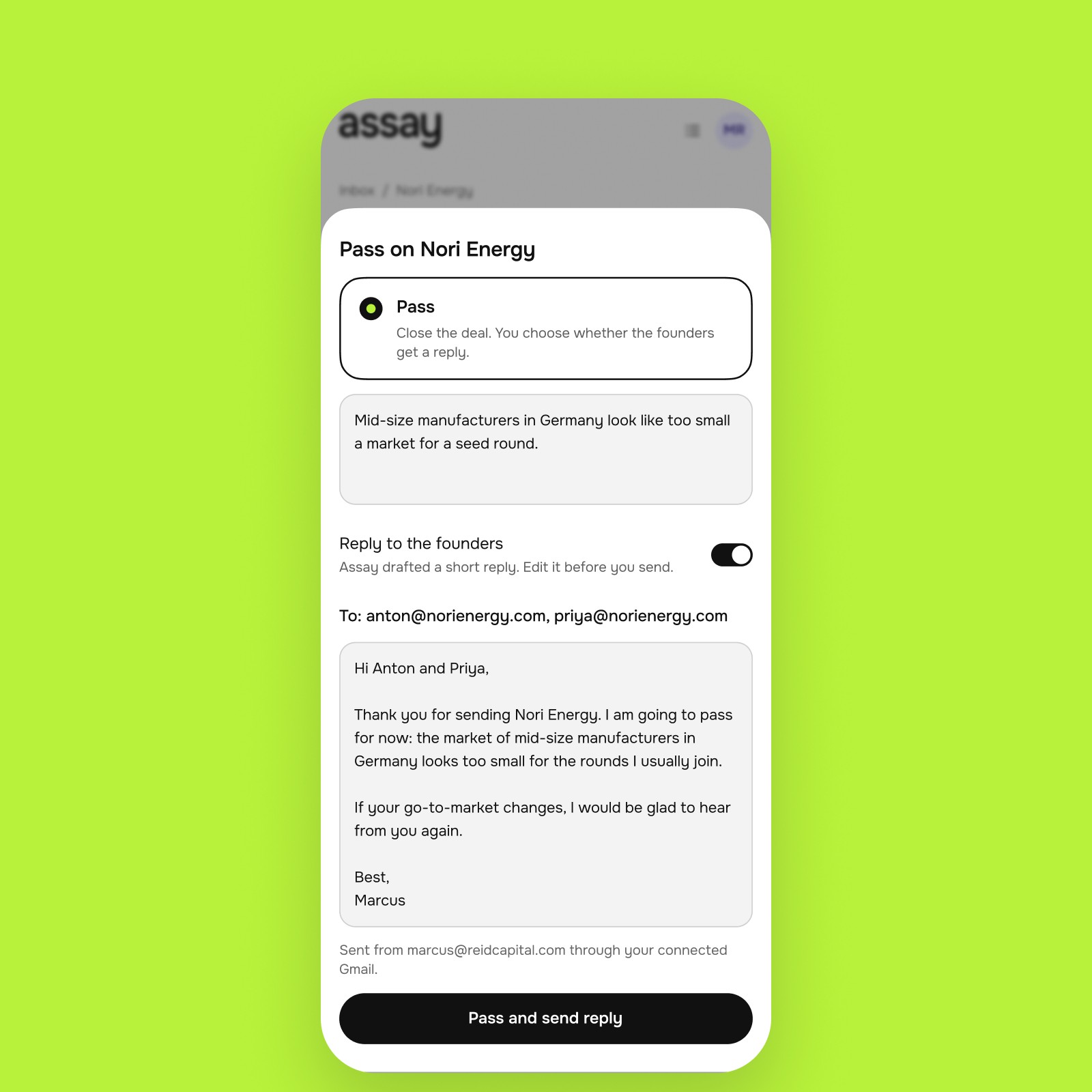
Pass comes with a reply
In venture, to pass is to decline, so the decisions became Advance, Dig deeper and Pass. After a Pass, Assay drafts a short reply to the founder that names one reason. Nothing is sent until the investor clicks.

Every deal against your own history
Open deals are ranked against everything the investor saw this year, so a deal in their top 28% means something to them.

Brand and design system
The first screens looked like every AI tool: near black, acid lime, mono labels. We renamed Verd to Assay, the test that tells real metal from a fake, and moved it to a light paper ground with white cards, one violet card per screen and lime only for the positive action.
One Figma library sits behind all 102 screens: colour, spacing and radius variables, Onest text styles and more than 50 components. Every text layer passes WCAG AA.

The landing page
Tools for investors usually hide their prices behind a sales call. Assay launches self-serve, so the page does the selling: what the product does in one line, a straight answer to why not just paste the deck into ChatGPT, a walk through the claims check, and the prices on the page.

Where it stands
Designed end to end and now in development
The product, the brand, the design system and the landing page are done. The app is being built in Next.js with Supabase and Stripe, with AI models reading the decks and checking the claims, for a US launch.
102
screens in 11 flows, with errors and empty states
50+
components in one Figma library, every text layer WCAG AA
3
decisions instead of a score: Advance, Dig deeper and Pass
More work
Other projects
What next
Want one like this?
Send us what you already have. We will tell you the simplest thing that solves it, even when that is less than you were expecting to buy.